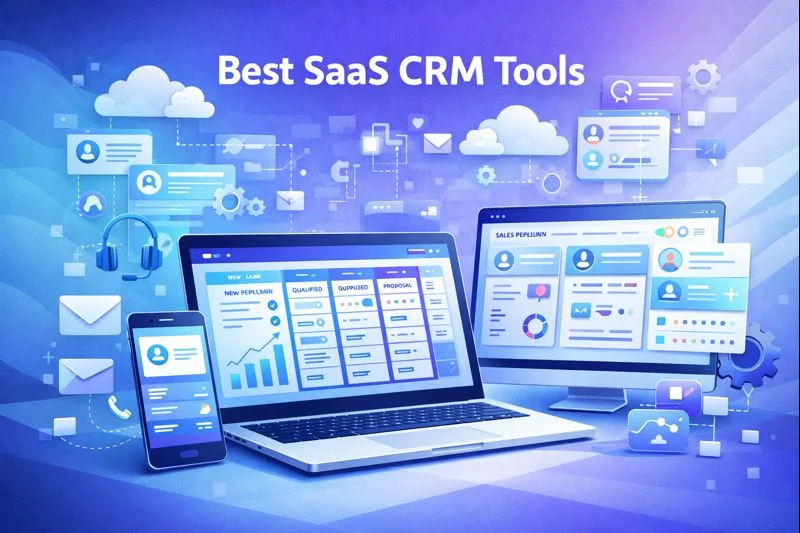
In 2025, Customer Relationship Management (CRM) software remains essential for businesses of all sizes — from small startups to large enterprises. The right SaaS (cloud-based) CRM software helps you manage leads, customers, sales pipelines, communication, automation, and analytics — all from one dashboard. Below are some of the top SaaS CRM platforms for businesses today, their strengths, and how to pick what suits you best.
Why SaaS CRM Is Crucial in 2025
Accessibility & flexibility: Being cloud‑based, SaaS CRMs work from anywhere — ideal for remote teams or businesses with mobile staff.
Scalability: SaaS CRMs let you scale up — add users, upgrade features, or integrate new modules as your business grows.
Automation & AI features: Many modern CRMs include automation (workflows, follow-ups) and AI‑powered lead scoring, forecasting, and insights — saving time and improving decision‑making.
All‑in‑one management: From contacts and leads to deals, marketing, communications, and analytics — everything is integrated, reducing the need for multiple disjointed tools.
Top SaaS CRM Software for Businesses in 2025
Here’s a rundown of the most recommended CRM platforms — based on features, price, scalability, and suitability for different business types:
HubSpot CRM
Best For: Startups, small to mid‑size businesses, agencies.
Pros: Free tier available; integrates marketing, sales, support; user‑friendly; strong marketing automation; good for inbound marketing, lead tracking, email campaigns, and contact management.
Cons: Advanced features (automation, advanced analytics) are locked behind higher‑priced plans — can get expensive when scaling.
Why Choose It: If you’re building websites, doing digital marketing and SEO, or managing multiple small clients (like you do), HubSpot offers a smooth way to manage contacts and marketing from one place.
Zoho CRM
Best For: Small to mid‑sized businesses, budget‑conscious teams, businesses needing customization.
Pros: Affordable pricing (free for up to 3 users, very low-cost paid plans), strong workflow automation, multi‑channel communication (email, phone, chat), AI assistant (Zia) for lead predictions and workflow suggestions, and customization options.
Cons: User interface is a bit dated, some performance and support issues in lower tiers, may not scale as cleanly as enterprise-grade CRMs when business grows large.
Why Choose It: If you want a flexible CRM without a heavy budget — perfect for e-commerce websites, small digital agencies, or startups that want to manage customers, leads, and follow-ups without overspending.
Pipedrive
Best For: Sales‑driven businesses, teams that prioritize pipelines, B2B companies.
Pros: Visual pipeline management (drag-and-drop), intuitive deal tracking, simple and clean UI, good automation for follow-ups and reminders, affordable for small teams.
Cons: Less strong in marketing automation or complex analytics compared to HubSpot or Zoho; fewer native advanced features — sometimes you need add-ons for email campaigns or marketing automation.
Why Choose It: If your main goal is managing sales pipelines, closing deals, tracking leads — Pipedrive is ideal. Good for small to medium sales teams, especially if you don’t need heavy marketing automation.
Freshsales (by Freshworks)
Best For: Small to medium businesses wanting easy‑to‑use CRM with built-in sales & communication tools.
Pros: Built-in phone and email integration, deal/contact management, automation, AI‑powered insights, clean UI; quick to deploy.
Cons: Less suited for complex enterprise-level workflows or deep customizations; advanced analytics or large-scale integrations may need higher plans.
Why Choose It: Good balance of features and simplicity — ideal for small businesses, online stores, or services where you want CRM + basic sales automation without heavy investment.
Salesforce Sales Cloud
Best For: Large businesses, enterprises, companies needing deep customization, advanced analytics, and robust integrations.
Pros: Extremely powerful CRM with advanced features — AI‑powered analytics (Einstein AI), highly customizable workflows, strong reporting, huge third‑party integration marketplace (AppExchange), and support for complex sales cycles.
Cons: Higher cost, steep learning curve; often requires dedicated resources or admins to manage effectively.
Why Choose It: If you run larger operations, multiple clients, or enterprise‑level projects needing robust CRM + analytics + sales + customer management — Salesforce offers the flexibility and power to handle complexity.
Which CRM Fits Your Business: Quick Match Guide
| Business Type / Need | Recommended CRM(s) |
|---|---|
| Startup / small business / limited budget | Zoho CRM, HubSpot CRM, Freshsales |
| Sales‑focused business / pipeline‑centric / B2B sales | Pipedrive, Freshsales |
| Balanced marketing + sales + automation (small‑mid teams) | HubSpot CRM, Zoho CRM, Freshsales |
| Growing business / need scalability & customization | Zoho CRM (higher tier), Salesforce Sales Cloud |
| Enterprise / complex sales cycles / need advanced analytics & integrations | Salesforce Sales Cloud |
| Quick setup, ease of use, minimal overhead | Pipedrive, Freshsales |
What to Consider When Choosing a SaaS CRM (Especially for Your Use Case)
Given that you design websites, manage e‑commerce, handle SEO, do digital marketing, and manage multiple clients:
Budget & team size: For small/medium clients or startups, cheaper SaaS CRMs (Zoho, HubSpot, Freshsales) give good value without over‑investing.
Automation & integration: Choose a CRM that supports automation (lead follow-ups, email campaigns), and integrates with your existing tools (CMS, e‑commerce, email services).
Ease of use & learning curve: If you want quick deployment for multiple clients, simpler tools with intuitive UIs (Pipedrive, Freshsales, HubSpot) are preferable.
Scalability: As your clients or projects grow, a CRM that scales — supports more users, advanced features, analytics — will avoid frequent migrations.
Sales vs. Marketing focus: If clients need primarily sales tracking and lead management → Pipedrive / Freshsales; if they need marketing automation + CRM → HubSpot / Zoho / Salesforce.
Trends & What’s New in 2025 SaaS CRM Software
AI‑powered CRM assistants & analytics: Modern CRMs (like Zoho, Salesforce) now often provide AI-driven lead scoring, predictive analytics, and smart workflow automation — helping businesses forecast sales and automate follow-ups.
All‑in‑one platforms: Many SaaS CRMs combine sales, marketing, customer support, communication (email, phone, chat), which is handy if you manage multiple aspects of a business under one roof.
Affordability + customization for SMBs: Tools are becoming more accessible for small businesses & startups, offering free or low‑cost plans but still giving robust CRM features.
Cloud-first, remote‑friendly design: SaaS CRMs continue to prioritize remote access, mobile apps, integrations — good for teams working from different locations or on the go.
Conclusion
There is no one-size-fits-all CRM — the best SaaS CRM software depends on your business size, needs, team structure, and goals.
For startups, small businesses, and marketing‑heavy work (like yours), tools like Zoho CRM, HubSpot CRM, Freshsales, Pipedrive are often the most cost‑effective and practical.
For growing businesses or enterprises needing scalability, advanced analytics, and complex workflows, Salesforce Sales Cloud (or a higher‑tier CRM) gives unmatched flexibility and power.
Because you manage websites, e‑commerce, clients, and marketing — picking a CRM that offers automation, integration, easy UI, and scalability will save you time and help deliver better results for clients.